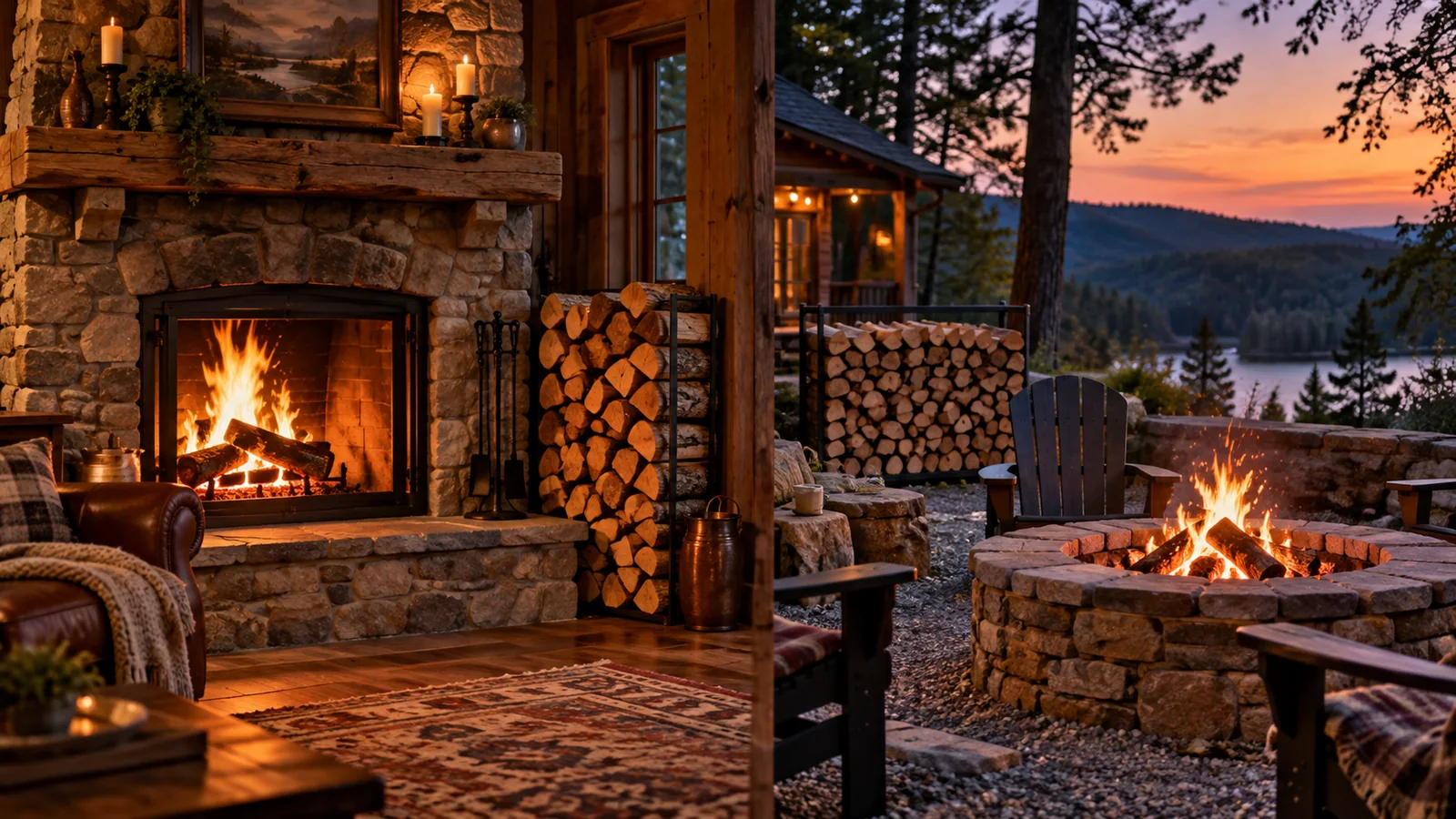
Indoor Hearth vs Outdoor Fire Ring: Why One Firewood Order May Not Fit Both
An outdoor fire ring and an indoor wood-burning fireplace may sit 30 feet apart and still need different wood, different quantities, and different handling. Plan for the fire you will actually build.
Quick answer
Outdoor rings usually tolerate larger splits and bigger fires. Indoor fireplaces require host approval, firebox-compatible log sizes, cleaner staging, and closer attention to draft and ash. If you plan to use both, say so when arranging wood.
Two fires, two jobs
Outdoor cabin fires are social. People sit around them, move chairs, roast food when permitted, and tend them over several hours. Indoor fires are part of the building. They are constrained by a chimney, firebox, screen, hearth, furniture layout, and the owner's operating rules.
That difference changes what “enough firewood” means. A weekend with one ninety-minute indoor fire is not the same as a weekend with two four-hour outdoor fires plus an indoor fire each night.
Side-by-side: what changes indoors and outdoors
| Factor | Indoor hearth | Outdoor fire ring |
|---|---|---|
| Host permission | Always confirm guest use and fuel rules | Confirm ring availability and current property rules |
| Split size | Must fit the firebox comfortably | Often tolerates larger pieces |
| Storage | Small, clean staged amount only | Main supply can remain in approved covered rack |
| Weather | Less exposed, but draft still matters | Wind and rain strongly affect use |
| Ash/sparks | Contained within building system | More open; wind can carry sparks |
| Typical use | Smaller controlled fire | Longer social fire, often larger |
Split size matters more indoors
A large split can be excellent for a roomy outdoor ring because it burns slowly and reduces constant feeding. The same piece may be too long for a small fireplace, difficult to position behind a screen, or prohibited by the host.
If the property has a stove, size matters even more. Stoves are designed around a particular firebox and air-control system. Ask about the correct log length rather than assuming the supplier's standard outdoor split will fit.
Dryness matters everywhere, but wet wood hurts more indoors
Wet or poorly seasoned firewood is frustrating outside. Indoors, it can also create a smoky, low-quality fire that never seems to establish a clean burn. You will use more kindling, spend more time tending it, and may create more smoke during startup.
Keep the main supply covered and off wet ground. Bring only a modest amount into the cabin in the place the host provides. Do not create a large indoor woodpile because it looks rustic.
Indoor storage is a cleanliness problem as much as a moisture problem
Bark, dirt, leaves, and insects travel with firewood. Outside, that is normal. Inside a rental, it becomes debris across the floor and can create problems for housekeeping.
If the cabin provides an indoor rack, use it. If not, keep the bulk supply outside in the approved dry location and bring in only what you expect to burn soon.
Outdoor fires are more exposed to weather
Wind, rain, and dry conditions can change the outdoor plan quickly. A beautiful outdoor ring does not mean it is always appropriate to use it. Follow the property's rules and any current fire restrictions.
On windy nights, sparks and embers can travel farther than guests expect. On wet nights, an uncovered pile can become difficult to light. Delivery timing and covered storage matter more when the forecast turns.
How to estimate a two-fire weekend
Describe the weekend in fire-hours rather than nights. For example: two people, two evenings, two hours outdoors before dinner, one hour indoors afterward. That is more useful to a supplier than “We are staying two nights.”
For a larger group, add the fact that the outdoor fire will likely be bigger and burn longer. Group size does not mechanically determine consumption, but it is a useful proxy for how the fire will be used.
When one order can work for both
If the host allows the same clean, seasoned local firewood in both places and the splits comfortably fit the indoor firebox, one supply may be fine. Separate some smaller pieces for indoor use and keep the rest staged outside.
If the host provides indoor wood but not outdoor wood, do not assume the indoor stack is fair game for the fire pit. That supply may be sized and budgeted specifically for the fireplace.
The simplest ordering language
When arranging firewood, say: “We have a wood-burning indoor fireplace and an outdoor fire ring. We expect to use both Friday and Saturday night.” Or: “Outdoor ring only, three adults, probably a three-hour fire each evening.”
That sentence gives the supplier more useful information than any generic request for “a weekend amount.”
What this means for a typical two-night cabin stay
Think through the trip in sequence: arrival, first-night fire, daytime plans, second-night fire, and checkout. The firewood decision is easiest before the first step. Once the group is settled, nobody wants to leave a warm cabin to solve a supply problem that could have been handled from the car.
That is why the practical questions in this guide are intentionally repetitive around type of fire, quantity, access, dryness, and property rules. Those five variables explain most firewood surprises without requiring a traveler to become an expert on wood species or combustion.
If you would be annoyed to discover the answer after dark, ask the question before check-in.
Burn profile matters more than species trivia for most guests
Travelers can spend too much time comparing oak, hickory, maple, cherry, and other hardwood names when the more immediate questions are whether the wood is dry, allowed by the property, and sized for the fire feature. Species affects density and burn characteristics, but a premium species delivered wet or cut too large is still a poor fit for the evening.
If the supplier offers multiple options, describe the use first. Let the seller recommend the appropriate dry local product rather than optimizing for a wood-species ranking you found online.
Outdoor fires often become larger because the group can see the whole pile
A visible stack beside the ring encourages frequent feeding. People add a log when the flames dip even though a strong coal bed remains. With a larger group, several people may tend the fire without realizing someone else just added wood. That can double consumption without anyone intending it.
Assign one person to tend the fire or stage only the amount you expect to use that evening near the ring. Keep the remainder in the storage rack. This simple boundary protects the weekend supply.
Indoor use rewards smaller staging
Bring in only the amount the host permits and you expect to use soon. Smaller staging keeps bark, dirt, insects, and moisture out of the living space and makes it harder to overload the firebox. If the cabin has a dedicated hearth rack, that is usually the intended staging zone.
Do not carry a large outdoor pile inside simply because rain is forecast. Ask the host where the bulk supply should remain dry.
Cooking changes the outdoor wood question
If the property allows cooking over the fire ring, confirm what fuel and equipment are appropriate. Do not assume every decorative fire pit is intended for food preparation. When cooking is allowed, avoid burning painted or treated wood, trash, packaging, or anything the host prohibits.
For many cabin guests, the simplest separation is ambience firewood for the ring and normal kitchen equipment for meals. That keeps the fire plan predictable.
When the weather forces a pivot
A weekend order sized for outdoor fires can feel excessive if wind or rain cancels the outdoor plan. That is another reason not to assume the same wood can move indoors. If the indoor fireplace accepts only host-provided wood, the delivered outdoor supply should remain in its approved storage location for the property.
Before ordering a large amount, check the forecast and the host's policy for unused wood. Flexibility matters more on shoulder-season weekends.
Think about the entire fire cycle, not only ignition
Indoor and outdoor fires differ at the end as much as at the beginning. Outdoors, the group needs enough time to let the fire burn down and follow the property's extinguishing procedure before leaving the area. Indoors, the last addition of wood should happen early enough that the fire can settle safely before everyone goes to bed.
That changes quantity planning. A giant last log at midnight is not useful just because it is still in the rack. Firewood should fit the schedule as well as the fireplace.
For a two-night stay, consider making the second-night fire slightly smaller. Departure morning already includes packing, dishes, trash, pets, and checkout. A smaller final fire reduces the chance that someone is dealing with hot coals while the rest of the group loads the car.
A two-night planning example
Suppose four adults arrive Friday and plan a three-hour outdoor fire, then a smaller indoor fire on Saturday after a long hiking day. That is not simply “two nights of firewood.” The outdoor portion may be the larger consumer, while the indoor portion requires compatible smaller splits and host approval. Tell the supplier the sequence and keep the indoor supply separate if the property does.
Thinking in sessions rather than nights makes the order easier to size and prevents the group from feeding Friday's fire as if every piece in the stack belongs to that one evening.
Simple rule Do not move wood from one fire feature to the other merely because it is convenient. Confirm that the same fuel is approved for both. The outdoor stack may be larger, dirtier, or simply outside the rules for the indoor appliance.
The same principle applies when you reorder mid-stay: tell the supplier which fire consumed the original supply. If the outdoor ring used most of the wood, the top-up may be different from a request for smaller indoor-compatible splits. A useful supplier conversation describes the remaining plan instead of simply repeating the first order.
Confirm the cabin allows outside delivery, then arrange local firewood using the exact property address, stay dates and approved drop point.
Ordering examples that tell a supplier something useful
Outdoor only: “Four adults, two nights, probably a three-hour fire each evening.”
Indoor only: “Two adults, two nights, wood-burning fireplace, host allows local outside wood, firebox takes smaller splits.”
Both: “Six adults, outdoor ring before dinner and indoor fireplace later, Friday and Saturday.”
These descriptions communicate use. “We need some wood” does not.
Firewood trip-planning glossary
| Term | Plain-English meaning for a cabin guest |
|---|---|
| Seasoned firewood | Wood that has been dried for burning rather than freshly cut green wood. |
| Kindling | Small dry material used to establish the first flame before larger splits are added. |
| Split | A piece of firewood that has been divided from a larger round. |
| Firebox | The chamber inside a fireplace or stove where fuel burns. |
| Damper | A control in some fireplaces that affects the exhaust path and draft. |
| Par level | For owners, the target inventory level to have ready for the next guest. |
One final check before travel day
Read the host's most recent arrival message rather than relying on the listing you booked months earlier. Property rules, access instructions, available amenities, and seasonal conditions can change. If the fire is important to the weekend, confirm it the same way you confirm the door code: close enough to the trip that the answer is current.
Frequently asked questions
Can I use the same hardwood indoors and outdoors?
Sometimes, if the property allows it and the splits fit the indoor firebox. Host rules control indoor use.
Which uses more wood, an indoor fireplace or outdoor ring?
It depends on size and duration, but large outdoor social fires often consume wood faster than a modest indoor fire.
Should I store all delivered firewood inside?
No. Keep the bulk supply in the approved dry outdoor location and bring in only the amount the host permits.
Does an outdoor fire ring mean fires are always allowed?
No. Property rules, weather, and temporary restrictions can still limit use.
What should I tell a supplier if I have both fire features?
Describe both, the number of nights, expected fire duration, and whether the host restricts outside wood indoors.
Information reviewed September 26, 2026. Property rules, weather conditions, business availability, and pest-quarantine boundaries can change. For legal firewood-movement questions, use current Ohio Department of Agriculture and Ohio Administrative Code sources.