Roadside Stand, Gas Station, or Delivery? The Best Firewood Option for a Hocking Hills Stay
Roadside stands, retail bundles, host-supplied wood, and cabin delivery can all solve the same problem. The best choice depends on when you arrive, how much you need, and how remote the rental is.
Quick answer
Roadside stands are great when they are on your route and stocked. Retail bundles are predictable for a small amount. Delivery is strongest for late arrivals, remote cabins, larger quantities, or travelers who want the problem solved before check-in.
There is no single “best” source
A couple staying one night near Logan has a different problem from twelve people arriving after dark at a secluded cabin. The first group may need one small bundle. The second may want the weekend supply stacked before the first vehicle arrives.
Choose the source based on the trip rather than assuming one buying method is universally cheaper or better.
Comparison table: what each option is good at
| Source | Best for | Main downside | Certainty |
|---|---|---|---|
| Host-supplied | Indoor compatibility and easiest guest rules | Quantity/price may be limited | High once confirmed |
| Roadside stand | Local wood on a convenient route | Stock and payment can be unpredictable | Medium |
| Retail bundle | Small quantity, emergency top-up | Gets cumbersome for long weekend use | High if store is open |
| Pre-arrival delivery | Remote cabins, groups, late arrivals, larger supply | Requires address/access coordination | High after confirmation |
Roadside stand: best when it is genuinely convenient
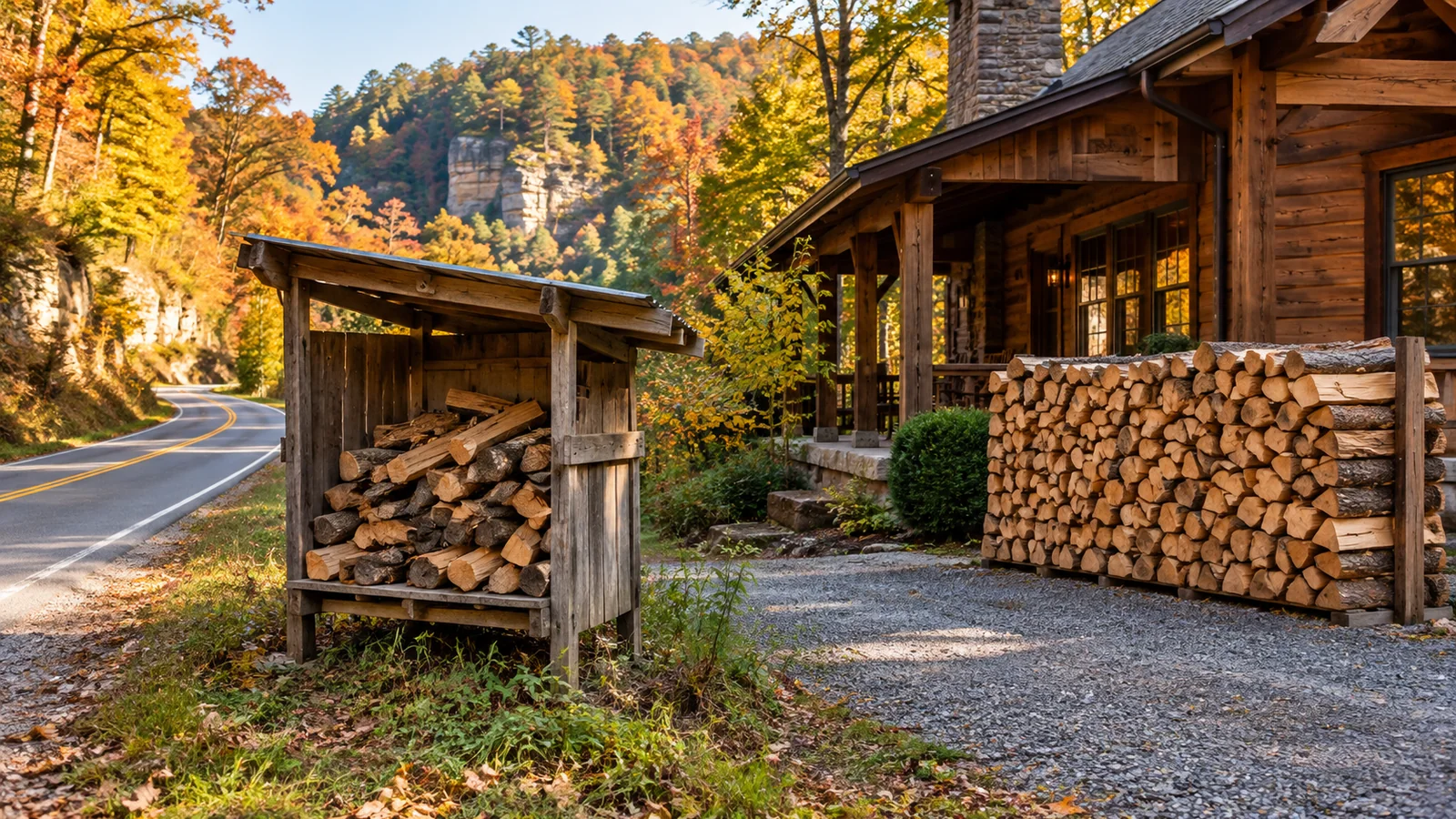
Roadside firewood is part of the Hocking Hills experience. When the stand is directly on your route, clearly priced, stocked with dry local wood, and uses an easy payment method, it can be the simplest option of all.
The weakness is uncertainty. A small stand can sell out on a busy weekend. It may be cash-only. You may pass it in daylight on the way to the cabin and discover later that you should have stopped.
If roadside is your plan, identify a stand before the final leg of the drive and have a backup.
Gas station or store bundle: predictable but usually small
Retail bundles are useful because they are recognizable and easy to load. If you are already buying ice, groceries, or fuel, adding a bundle costs almost no extra travel time.
The downside appears when you scale up. A group that wants long fires on multiple nights may need many bundles, creating repeated handling and a price that is difficult to compare with a larger delivered quantity.
Retail is excellent for a top-up or one evening. It is less elegant as a weekend logistics strategy when the fire is central to the stay.
Host-supplied wood: highest compatibility
If the cabin sells or includes wood, that is often the safest choice for an indoor fireplace because the host has already decided what belongs in the appliance. It also eliminates the movement question and avoids a separate delivery vendor.
The tradeoff is that you may not know the price or quantity until you ask, and not every property keeps extra stock.
Delivery: buy back your vacation time
Delivery is not only about avoiding a drive. It is about removing uncertainty from the arrival sequence. This matters when the rental is remote, the group is arriving in multiple vehicles, children or pets make stops harder, or the last hour of the drive will happen after dark.
A pre-arrival drop can also solve quantity better than retail bundles because you can order around your actual number of fire-hours rather than guessing from what fits beside a checkout counter.
The hidden cost is often the detour
Vacation-time economics are different from household economics. A five-dollar difference in wood price may not matter if the cheaper option adds forty minutes of driving, requires cash you do not have, or sends someone back out after dinner.
Compare the total friction: travel time, certainty, quantity, dryness, payment method, and whether the wood is acceptable at the property.
When each source wins
| Scenario | Likely best fit | Why |
|---|---|---|
| One-night couple, early check-in | Host supply or retail bundle | Small quantity, easy to solve on route |
| Late Friday arrival | Pre-arrival delivery or host supply | Removes after-dark errand |
| Large group, two outdoor fire nights | Delivery | Quantity and certainty matter more than portability |
| Indoor fireplace only | Host supply first | Best match for appliance rules |
| Already stopping for groceries/fuel | Retail bundle or known local stand | No dedicated detour |
A note on moving firewood
Firewood can carry invasive insects and other pests. Ohio maintains pest quarantines that regulate the movement of certain wood and plant materials, and the regulated areas can change. The traveler-friendly habit is to buy near the place where you will burn rather than hauling loose firewood long distances from home.
If you plan to transport firewood through or out of a regulated area, check the current Ohio Department of Agriculture rules rather than relying on an old blog post or a blanket county-line rule.
Build a two-option plan before the trip
Pick a primary source and one backup. For example: delivery arranged for the cabin, with a retail bundle available near your grocery stop if weather delays the drop. Or host-supplied wood as the primary, with a local stand as the top-up option.
The best firewood strategy is the one that never forces the group to solve the problem at 9:00 p.m.
What this means for a typical two-night cabin stay
Think through the trip in sequence: arrival, first-night fire, daytime plans, second-night fire, and checkout. The firewood decision is easiest before the first step. Once the group is settled, nobody wants to leave a warm cabin to solve a supply problem that could have been handled from the car.
That is why the practical questions in this guide are intentionally repetitive around type of fire, quantity, access, dryness, and property rules. Those five variables explain most firewood surprises without requiring a traveler to become an expert on wood species or combustion.
If you would be annoyed to discover the answer after dark, ask the question before check-in.
Late arrival is the biggest reason to change the buying method
A roadside stand is wonderful at 3:00 p.m. when you have cash, daylight, and no schedule pressure. The same stand is not a plan at 10:00 p.m. if it is empty, dark, or behind you by twenty miles. If the first-night fire matters and check-in will be late, choose a source that can be confirmed before the final drive.
Delivery or host-supplied wood buys certainty. Retail buys certainty only if you know the store hours and stop before entering the rural part of the trip.
Rainy weekends reward covered storage more than cheap price
A low price on uncovered roadside wood can lose its advantage if the stack has been sitting in rain. Look at the condition of the wood and the seller's storage, not just the sign. For delivery, confirm where the wood will be left and whether that location protects it from weather.
A dry smaller supply can produce a better weekend than a larger wet one.
Payment method is part of convenience
Small stands may use cash, honor boxes, QR codes, or peer-to-peer payment. Cellular service may be weak where the stand is located. If you intend to use a roadside option, carry a reasonable mix of payment methods and do not assume a mobile payment will load instantly.
For delivery, pay or confirm payment before you reach the cabin whenever possible. That reduces the number of dependencies on rural connectivity.
Inspect before buying when you can
Look for wood that appears dry and split for firewood use rather than a pile of fresh green rounds. Pieces should be a manageable size for your intended fire. If you need indoor fireplace wood, compatibility matters more than a bargain price.
When buying wrapped retail bundles, check that the packaging is intact and the wood is not visibly saturated.
Campground and cabin trips are different buying problems
A campground may have its own firewood rules, onsite sales, and restrictions that differ from a private rental. A cabin owner may allow local outside delivery to an outdoor ring but restrict the indoor fireplace. Do not transfer a rule from one setting to the other.
Before buying, ask one question: where exactly will this wood be burned? The answer determines which rule set matters.
A backup source is worth identifying even when you do not expect to use it
Travel plans fail in ordinary ways. A stand is sold out, the host's rack is smaller than expected, rain soaks an uncovered supply, or the group decides to stay outside longer than planned. Before the trip, identify one backup option near the cabin or along the next day's route.
The backup does not need to be the cheapest seller in the region. It needs to be reachable, open when you might need it, and appropriate for the property's fire rules. Saving the name and location before the trip is enough.
This is especially helpful for fall weekends when traffic, early darkness, and high cabin occupancy can make last-minute errands more annoying than they would be on a quiet weekday.
Do not let the buying method override the cabin's rules
A great roadside deal is irrelevant if the owner prohibits outside wood in the indoor fireplace. A perfect delivery is unnecessary if the host already includes the full weekend supply. Start with the property policy, then choose the most convenient legal source that fills the actual gap.
This order of operations prevents the most common waste: buying first and asking permission second.
Choose for the trip you actually have The best source on a quiet Tuesday afternoon may be the worst source for a Friday-night arrival in peak fall season. Time of day, traffic, group size, and how central the fire is to the stay should all influence the buying method.
Confirm the cabin allows outside delivery, then arrange local firewood using the exact property address, stay dates and approved drop point.
The five-minute decision
- Are you already passing a known stocked stand or store?
- Are you arriving before dark?
- Do you need only a small amount?
- Does the cabin permit outside wood for the intended fire?
- Would a dedicated stop meaningfully interrupt the trip?
If the first three answers are yes, pickup is easy. If arrival is late, quantity is larger, or the property is remote, delivery becomes more attractive.
Firewood trip-planning glossary
| Term | Plain-English meaning for a cabin guest |
|---|---|
| Seasoned firewood | Wood that has been dried for burning rather than freshly cut green wood. |
| Kindling | Small dry material used to establish the first flame before larger splits are added. |
| Split | A piece of firewood that has been divided from a larger round. |
| Firebox | The chamber inside a fireplace or stove where fuel burns. |
| Damper | A control in some fireplaces that affects the exhaust path and draft. |
| Par level | For owners, the target inventory level to have ready for the next guest. |
One final check before travel day
Read the host's most recent arrival message rather than relying on the listing you booked months earlier. Property rules, access instructions, available amenities, and seasonal conditions can change. If the fire is important to the weekend, confirm it the same way you confirm the door code: close enough to the trip that the answer is current.
Frequently asked questions
Is roadside firewood a good choice in Hocking Hills?
Yes when the stand is local, stocked, dry, and convenient to your route. Availability can be less predictable than retail or arranged delivery.
Are gas-station bundles bad firewood?
Not inherently. They are often convenient for a small quantity; check that the wood is dry and appropriate for where you plan to burn it.
Why pay for delivery?
Delivery can remove a detour, guarantee a larger quantity, and have the wood waiting before a late or complicated check-in.
Should I bring firewood from home to save money?
Buying near where you burn is the simpler pest-prevention habit and avoids navigating changing quarantine rules.
What is the best option for an indoor fireplace?
Host-provided wood is often the clearest fit; otherwise confirm that outside locally sourced wood is permitted before buying.
Information reviewed September 26, 2026. Property rules, weather conditions, business availability, and pest-quarantine boundaries can change. For legal firewood-movement questions, use current Ohio Department of Agriculture and Ohio Administrative Code sources.