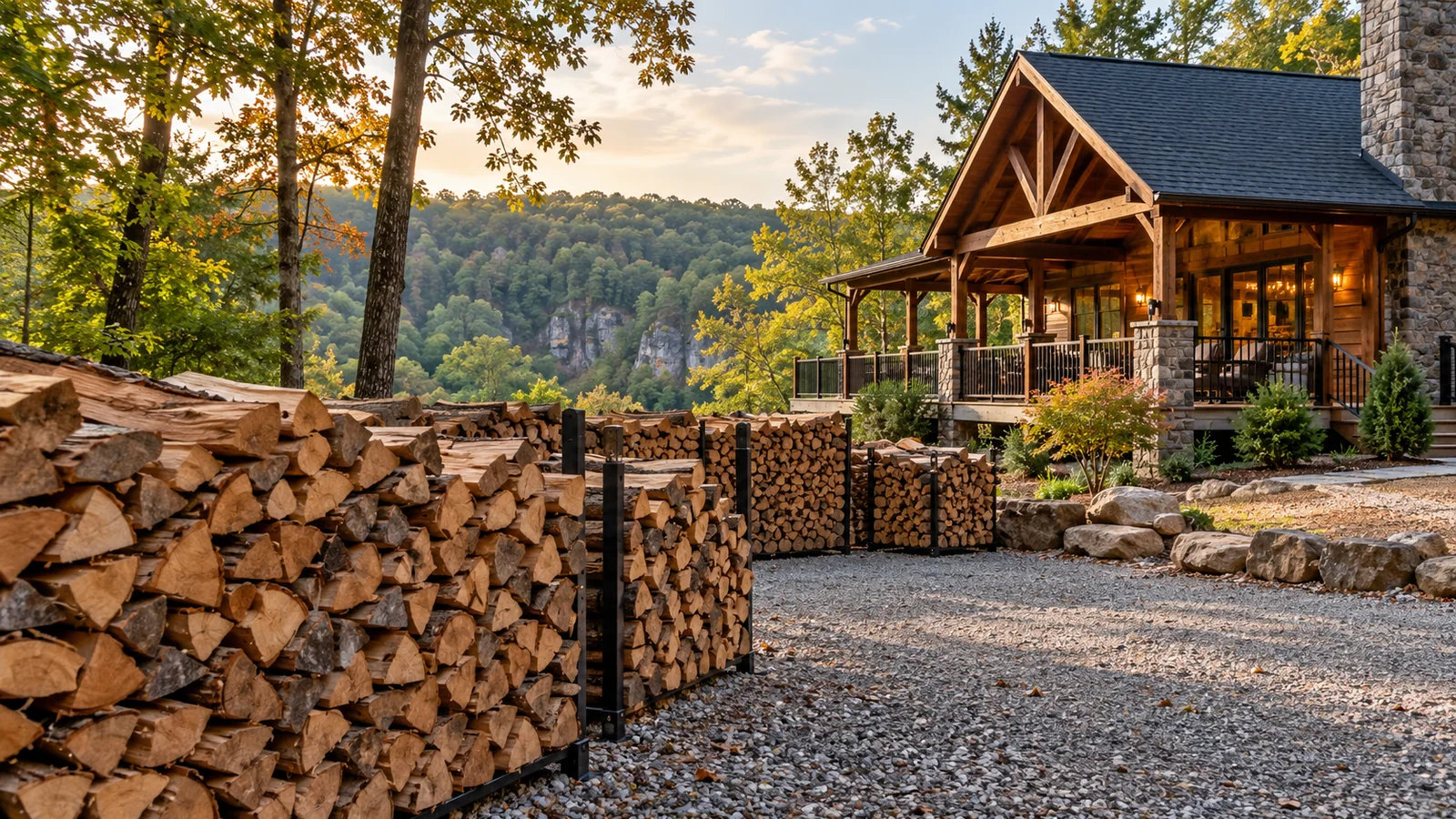
How to Build a Guest-Ready Firewood Station at a Hocking Hills Rental
A good firewood station is not just a pile under a roof. It tells guests what they may use, keeps wood dry, separates guest stock from reserve inventory, and gives the turnover team a clear restock trigger.
Quick answer
Design the station around four jobs: keep wood dry, make the guest supply obvious, prevent unsafe stacking near the structure, and make restocking measurable. If the cleaner cannot tell whether the station is ready in one photo, the system is too vague.
Why firewood becomes an operations problem
A cabin owner can spend thousands of dollars on a fire ring, landscaping, outdoor chairs, and a dramatic stone fireplace, then let the guest experience hinge on an unlabeled pile of wet logs. That is backwards.
Firewood is inexpensive compared with the property, but it touches guest satisfaction, safety, housekeeping, and turnover. The station should therefore be designed like any other guest amenity: obvious, repeatable, and easy to inspect.
The four-zone station
| Zone | Purpose | Owner decision |
|---|---|---|
| Guest rack | The amount guests are invited to use | Included quantity and resupply policy |
| Reserve | Protects the next turnover | Who may access it and when it triggers delivery |
| Kindling/starter | Makes the amenity actually usable | What is provided and how it stays dry |
| Indoor-only supply | Wood sized/approved for fireplace or stove | Whether it is separate from outdoor stock |
Choose a location guests can understand at night
The best station is close enough to the approved fire area that a guest naturally finds it but not so close to the cabin, stairs, or parking area that it becomes a hazard. Avoid locations where guests must walk behind maintenance buildings, across muddy slopes, or through an owner-only area.
Think about the property at 10:00 p.m. under porch lights, not at noon during a maintenance visit.
Cover the top and preserve airflow
Firewood needs protection from direct rain and ground moisture, but sealing it tightly under plastic can trap moisture. A simple roofed rack with open sides is often easier to operate than a loose pile under a tarp.
Elevate the bottom course off soil. Keep the stack stable. Do not let wood lean into siding, railings, HVAC equipment, or utility access.
Separate guest stock from reserve stock
If every piece of wood on the property looks available, guests will reasonably assume it is. That is a problem if part of the inventory is intended for the next turnover or for owner use.
Make the included guest amount physically distinct. The reserve can live in a second rack, locked enclosure, maintenance area, or simply a clearly marked location that is not part of the guest amenity.
Decide what is included and say it plainly
Three workable models are common: all firewood included, a defined starter amount included with more available for purchase, or no wood included but ordering instructions provided.
Any of those can work. Ambiguity is what fails. Put the policy in the listing, pre-arrival message, and at the station. Guests should not have to text “Are we allowed to use this pile?”
A sample sign that does real work
A useful sign is short: “Guest firewood: this rack is included for the outdoor fire ring. Need more? Text [contact]. Indoor fireplace uses host-provided wood only. Please keep wood in the rack and fully extinguish fires before leaving the area.”
Adapt the language to the property. The point is to answer quantity, location, indoor/outdoor use, and resupply in one glance.
Kindling and fire starters: decide intentionally
If you provide them, keep them dry and clearly separate from the main logs. If you do not provide them, tell guests before arrival. A station full of large splits without a way to start them generates the same complaint as an empty station.
Avoid leaving loose flammable liquids or anything that invites unsafe experimentation.
Add the station to every turnover
Firewood is not a seasonal decoration. If it is listed as an amenity, it needs an inspection every turnover. The cleaner or maintenance person should record the guest rack level, whether the wood is dry and covered, whether kindling needs replenishment, and whether the area is clean.
A single photo can document all four.
A restock threshold that is impossible to debate
Do not write “restock when low.” Mark a line on the rack, define a minimum number of containers, or use a photo showing the minimum acceptable fill. That gives the turnover team an objective trigger.
Objective triggers are what allow a remote owner to manage the amenity without emergency messages.
Design for the worst weekend, not the average Tuesday
Fall foliage weekends, holidays, cold snaps, and large groups can consume more wood. Maintain a reserve that absorbs an unusually heavy stay without leaving the next guest empty.
Seasonal demand should change the par level, not the basic process.
Guest-ready station audit
- Guest rack is stable, covered and off wet soil
- Station does not block doors, steps, parking, HVAC or utilities
- Included quantity is obvious
- Indoor-only and reserve wood are separated when necessary
- Kindling / starter policy is clear
- “Need more?” instructions are visible
- Turnover checklist includes a photo
- Restock threshold is objective
- Supplier has permanent property profile and drop instructions
- Seasonal reserve is adjusted before fall and holidays
What good operations look like to the guest
The guest should not see the inventory system. They should see a clean rack, clear instructions, dry wood, and an easy way to obtain more. Behind that simple experience can be a turnover photo, a supplier trigger, a reserve level, and a spreadsheet. The operational machinery exists so the amenity feels effortless.
That distinction matters for reviews. Guests rarely praise an inventory process, but they absolutely notice when a listed amenity is empty, wet, confusing, or unavailable. A few minutes of repeatable turnover work protects an experience the property has already advertised.
Design the station around housekeeping, not photography
A station can look beautiful in a listing photo and still be annoying to operate. If cleaners have to remove a fitted cover, walk down a steep slope, or rearrange decorative pieces to estimate inventory, the station will not be checked consistently. The operational version should be accessible, visible, and easy to photograph from one repeatable angle.
Pretty is welcome. Observable is essential.
Choose capacity from actual guest behavior
Do not size the rack by guess. Start with a reasonable guest-ready amount, then compare turnover photos with occupancy and season. If the rack is routinely half full after weekend stays, the target may be higher than necessary. If it repeatedly falls to zero, increase the target or reserve.
Different properties can have different par levels. A romantic two-person cabin and a 16-person lodge should not automatically receive the same guest supply.
Keep the station clean enough that guests trust the wood
Remove broken plastic wrap, old starter packaging, leaves that trap moisture, and trash from previous guests. Keep the surrounding area free of nails, unstable pallets, and loose pieces that roll into walkways. A clean station signals that the amenity is intentional rather than leftover material from property maintenance.
Use signage to prevent indoor/outdoor mix-ups
If the same property has an indoor wood-burning fireplace and an outdoor ring, guests need to know whether the supplies are interchangeable. A simple label such as “Outdoor fire ring wood” or “Indoor fireplace: use rack beside hearth only” prevents guests from moving the wrong stock.
This is particularly important when indoor logs are smaller or when the host prohibits outside wood in the fireplace.
Decide how guests obtain more before the rack is empty
If extra wood is sold, make the purchase process obvious. If the host wants guests to contact a supplier, provide that instruction before arrival. If no additional wood is available, say so. Guests will make better first-night decisions when they know the limit.
The worst policy is an invisible one: a starter amount that looks unlimited until the guest discovers the reserve is off limits.
Quality-control photos for remote owners
Ask for one wide photo showing the full station and one close photo only when there is a problem such as wet wood, damage, or low kindling. Too many photos create noise. The wide image should be enough to answer the normal question: is the station ready for the next guest?
Plan the station for every season it will be advertised
A rack that works in July may fail in November when leaves accumulate around it, daylight disappears early, and rain blows under a shallow roof. A location that is easy to reach in dry weather may become muddy during spring. If the amenity is marketed year-round, inspect it under the conditions guests will actually experience.
Exterior lighting matters too. Guests carrying wood after dark should not have to cross an unlit slope or step around landscape rocks they cannot see. The goal is not to flood the property with light; it is to make the approved path obvious.
Before winter, also decide whether snow removal includes the route to the firewood station. A perfectly stocked rack is not guest-ready if it is behind a snowbank or down untreated steps.
Make the station easy to explain in the listing
The physical station and the listing copy should agree. If the listing says “firewood included,” the rack should contain a clearly defined guest supply at check-in. If only a starter amount is included, say “starter firewood provided; additional wood available” rather than using language that implies unlimited fuel.
Clear listing language qualifies guest expectations before arrival and makes the onsite signage feel like confirmation instead of a surprise restriction.
Owner test Ask a person who has never visited the property to find the guest firewood after sunset using only the arrival instructions. If they cannot locate the right rack, tell what is included, and understand how to get more without calling you, the station still needs work.
Define the property, target stock level, delivery point and restock trigger once. Then use the same process every turnover.
Example turnover SOP
- Photograph the guest rack on arrival.
- Remove trash and obvious wet debris from the station area.
- Compare rack level with the marked minimum.
- Check kindling or starter inventory if provided.
- Confirm indoor-only rack separately when applicable.
- Submit restock request before leaving property if below threshold.
- Photograph the completed station after any same-day restock.
This procedure is intentionally simple. A system that requires weighing wood or counting every split is less likely to be followed consistently.
Firewood trip-planning glossary
| Term | Plain-English meaning for a cabin guest |
|---|---|
| Seasoned firewood | Wood that has been dried for burning rather than freshly cut green wood. |
| Kindling | Small dry material used to establish the first flame before larger splits are added. |
| Split | A piece of firewood that has been divided from a larger round. |
| Firebox | The chamber inside a fireplace or stove where fuel burns. |
| Damper | A control in some fireplaces that affects the exhaust path and draft. |
| Par level | For owners, the target inventory level to have ready for the next guest. |
One final check before travel day
Read the host's most recent arrival message rather than relying on the listing you booked months earlier. Property rules, access instructions, available amenities, and seasonal conditions can change. If the fire is important to the weekend, confirm it the same way you confirm the door code: close enough to the trip that the answer is current.
Frequently asked questions
Should firewood be stacked directly against the cabin?
No. Use an owner-approved location with appropriate separation from the structure, utilities, doors, and walkways.
Should the guest rack be unlimited?
That is a business decision. The important part is making the included quantity and resupply policy clear.
Who should inspect the station?
The person already visiting at turnover is the most efficient inspector, usually cleaning or maintenance staff.
What is the best restock trigger?
A visible objective threshold such as rack height, container count, or a comparison photo.
Should indoor and outdoor firewood be stored together?
Only if the same wood is approved for both and the property's system makes that clear. Many owners benefit from separating the two.
Information reviewed September 26, 2026. Property rules, weather conditions, business availability, and pest-quarantine boundaries can change. For legal firewood-movement questions, use current Ohio Department of Agriculture and Ohio Administrative Code sources.